by Kyla Sisson
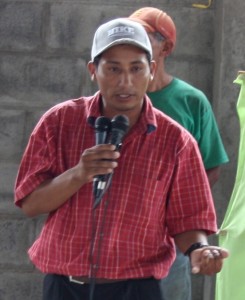
On Sunday, October 14th, Tomas Gómez Membreño (indigenous organizer with the Civic Council of Popular and Indigenous Organizations of Honduras, pictured to the right) and Riahl O’Malley (from Witness for Peace) participated in a roundtable discussion at Casa Guadalupana in St. Paul, MN.
On Sunday, Oct. 14, our friends at Casa Guadalupana in St Paul hosted a roundtable discussion led by Riahl O’Malley, member of Witness for Peace, and Tomas Gómez Membreño, indigenous organizer with COPINH (Civic Council of Popular and Indigenous Organizations of Honduras). Tomas and Riahl spoke about how US policies that protect capitalist interests affect indigenous peoples in Honduras.
Since the coup d’etat that overthrew democratically elected Manuel Zelaya in June 2009, Honduras has been hard to find in the news. Witness for Peace, which has been sending delegations from the US to Honduras since the coup, provides this update from Honduras:
Since the coup, human rights conditions in Honduras have deteriorated. Among those most affected by the post-coup violence are human rights advocates, journalists, women and members of the GLBT community.
Post-coup, Honduras withdrew from ALBA [Bolivarian Alliance for the Peoples of Our America], attempts have been made to roll back Zelaya’s minimum wage hike, and laws have been proposed to privatize public resources such as rivers for dam projects. The Honduran business elite, which played a key role in instigating and financially maintaining the coup, is intimately tied to U.S. and transnational corporate interests.
Neoliberal policies and targeted political repression and violence have expanded under the government of Porfirio Lobo. Lobo became president in January 2010, amidst international claims that the elections had been fraudulent and unfair.
However, despite the flagrant human rights violations and widespread impunity, the United States continues to support Honduras both diplomatically and through military aid. ( www.witnessforpeace.org )
Tomas is a member of the Lencan people, an indigenous community in the southwest of Honduras. He described how important land is to the Lencan people. “To us,” Tomas said, “water represents life.” He explained that the indigenous “cosmovision” or spirituality integrates a daily reliance on and cooperation with water, forests, and the land. In the capitalist system, resources such as water are seen by corporations as a resource to be harnessed and profited from. Factories require water and electricity to operate and create products.
Even the air has become a resource that can be bought and sold. COPINH has been active in speaking about and resisting “Green Capitalism,” which co-opts the language and aims of environmental movements to profit corporations and business interests. One such program launched by the UN called REDD-Plus (Reducing Emissions from Deforestation and forest Degradation) proposes to address climate change by taking control of existing forests in developing countries, which will then be managed by private companies instead of the indigenous communities that have preserved them for hundreds of years. Countries participating in this program are required to measure the amount of carbon offset by the trees in their forests, which is valued and “sold” to developed countries such as the United States who continue to contribute disproportionately to climate change. Tomas describes this process as the “privatization of oxygen,” to which indigenous peoples in Honduras and other developing countries are vehemently opposed.
So when large corporations come into the community to take over forest homelands or to build hydroelectric dams that would privatize the water necessary to the Lencan way of life, people organize themselves to resist. Numerous Hondurans resisting capitalist land-grabs have been imprisoned, disappeared and assassinated, reported by the government and the mainstream media to be criminals. This month in the region of Atlantida, a group of peasants demonstrating for the restoration of their land was attacked: two were killed, a dozen disappeared, and fourteen are being detained in an unknown location ( www.copinh.org ). <
The United States have supported this type of repression in Honduras by continuing to supply military aid to Honduras and funding for the security forces that helped bring current president Lobo to power. Military force is an important method of protecting capitalist interests worldwide. US corporations have major investments in agriculture and mining in Honduras. Since the coup, the US has built three new military bases in a country smaller than the state of Ohio. These are said to be in place to combat drug trafficking, but drug raids directed by the US have killed civilians, including a group of indigenous people on May 11, 2012, and the bases serve to intimidate Hondurans from acting in opposition to the government.
Hondurans are calling on United State citizens to demand that our government stop providing military funding to Honduras. Witness for Peace provides the means to take action through campaigns to contact government representatives. The organization also supports taking direct action to demand that those in power end unjust practices.
At the close of the roundtable, Tomas emphasized that the Lencan people do not believe in borders. “They have been painted,” he said, “but we were not the ones who painted them.” As human brothers and sisters, we are related across these created boundaries, Tomas explained, and our actions affect each other. As people of faith, it is our responsibility to act against the capitalist forces that seem to offer us cheap goods and convenience, but which cost our brothers and sisters their lives.
What You Can Do:
-Contact government officials to tell them to stop sending military funding to Honduras. Riahl states that even simple online petitions and form letters can help when Witness for Peace organizers call representatives and present the number of their constituents who have expressed this demand.
-Notice where things are made. If you buy things from other countries, purchase fairly traded goods.
-Break the habits of capitalism: borrow things instead of buying them. Barter, give gifts, make your own, and use less. Choose at least one day a week to spend time with people and turn off the “things” (computers, phones, MP3 players/stereos, cars, etc).
-Organize a direct action (witness with your body) in front of a representative’s office or the offices of a corporation with interests in Honduras.
-Attend the annual protest Nov 16-18 at the School of the Americas, a US training center for Latin American military forces who execute state repression in their home countries. In many cities, including Minneapolis, college groups and other organizations make plans to travel to Fort Benning, GA together for the event. Find out more at www.SOAW.org
Learn More:
– Open Veins of Latin America: Five Centuries of a Pillage of a Continent: further reading on the history of capitalism in the Americas.
-For Spanish speakers: www.copinh.org has up-to-date news about the popular resistance in Honduras. Tomas advises that the information is not always complete, since the government routinely hacks the website to remove information they with to remain secret.
-Witness for Peace Speaker Tour: Tomas will be continuing to speak throughout the Midwest this month. See if he will be coming to a city near you at www.witnessforpeace.org (under “Upper Midwest”).